1. Store foundation and profitable positioning
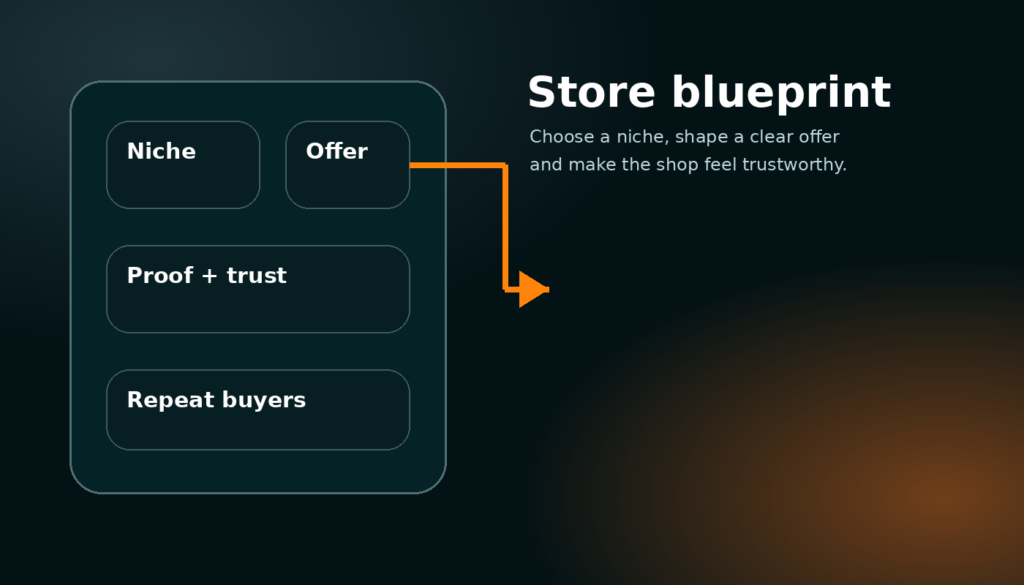
Decide who the store is for, what you sell, why buyers should trust you and how the whole shop earns money instead of just looking busy.
Choose a focused maker offer
A profitable Synthix store starts with focus. Do not begin by uploading every project, every material and every random idea you can make. Start by choosing one buyer group and one problem you can solve better than a general marketplace. A buyer should quickly understand whether you make replacement parts, custom desk accessories, cosplay pieces, signs, workshop jigs, personalised gifts, CAD help, laser cutting, 3D printing batches or another clear offer. The clearer the offer is, the easier it is for the homepage, shop cards, service cards and search pages to send the right buyer to you.
A focused store can still grow later. The point is to make the first impression simple. If a buyer sees 3D prints, woodworking, digital art, random courses and repair services all mixed together with no explanation, they may not trust any one of them. A focused store says: “I help this type of customer get this result.” Once that promise is clear, products, services, courses and quote requests all support the same business instead of feeling like separate unfinished experiments.
Write the offer in normal language. A good example is “Custom 3D printed parts for desks, gaming setups and small repairs” or “Laser cut signs and display pieces for small businesses.” A weak example is “I make stuff” because it gives the buyer no reason to keep reading. This first decision affects titles, banners, tags, product descriptions, service pricing and even what pictures you should upload.
Specific choice: product store, service store or mixed store
Use products when the buyer can understand the item, price and delivery before speaking to you. Use services when the buyer needs custom sizing, custom material, a file check, design time, local collection, unusual volume or a quote before you start. A mixed store works well when the fixed products act as proof and the service offer captures bigger custom jobs. For example, a maker could sell standard wall hooks as products and also offer “custom bracket design and printing” as a service. The product builds trust, the service creates larger order value.
Do not force every custom job into a fixed product just because checkout is easier. Custom work usually needs a conversation, a scope, a deposit and final approval. That is exactly why the service and quote system exists.
Common problem: the shop feels active but not profitable
This usually happens when the store has many small listings but no clear path to a valuable order. Ten low-priced products can look busy, but if each one takes too long to make, pack and support, the store can lose time. Add at least one higher-value service or bundle, and make sure every low-priced item either has a healthy margin, leads to repeat orders or demonstrates work that can turn into a custom quote.
When reviewing your own store, ask: what is the most profitable thing I want buyers to do next? The dashboard, shop layout and product cards should push buyers toward that action.
Build trust before asking for money
Trust is the difference between a marketplace listing and a real store. Add a proper profile image, a clean banner, a direct shop description, visible examples of previous work, realistic turnaround information and clear delivery expectations. Buyers do not only judge the item; they judge whether the maker looks organised enough to finish the job. A good banner should show your type of work or your brand style. A good profile image can be a logo, workshop mark or clean avatar, but it should not look like a missing placeholder.
The storefront follow button matters because it turns one-time visitors into future buyers. When someone follows a maker, new products, services, courses or important posts can become notifications. This is more valuable than a simple favourite button because it gives the store a way to build an audience. A buyer may not need a custom part today, but if they follow you, they can come back when they do.
Use the settings page to keep store details accurate. If orders are closed, say so. If custom orders are open, make that obvious. If you only work locally or only ship within certain areas, put it in the service details so buyers do not waste time contacting you for work you cannot do.
Specific setup: what your storefront header should prove
The storefront header should answer four questions fast: what do you make, who is it for, how can someone buy or request work, and why should they trust you? Keep the first line short. Put detailed policies lower down. Use the follow section to show that buyers can stay updated. Use cards below the header to show products, services and courses in rows instead of creating a long confusing wall of text.
Common problem: buyers message but do not buy
If many people ask questions but few buy, the page may be missing price guidance, turnaround, size options, examples or proof. Add a “starting from” price for services, clearer product variations and example images that show scale. Buyers often message because they are unsure, not because they are ready. Reduce uncertainty directly on the listing page.